
Silicosis Lawsuit


Written by Terry Turner, Legally Reviewed by Whitney Ray Di Bona, Esquire
Manufacturers of quartz and other countertop products are among those facing silicosis lawsuits. Employees exposed to unsafe levels of silica dust may develop silicosis and other damaging illnesses, leading to legal liability for employers who fail to protect employees.
Latest Updates in Silicosis Lawsuits
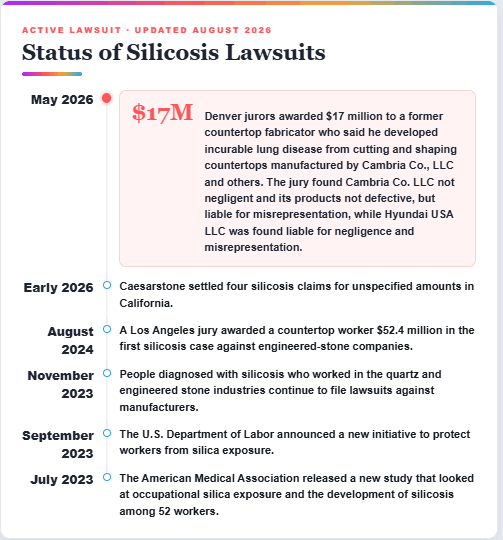
Silicosis lawsuits against engineered-stone countertop manufacturers are active and growing. In April 2026, a Denver jury awarded roughly $17 million to a former countertop fabricator who developed the devastating lung disease. More workers continue to file claims. No formal multidistrict litigation (MDL) has been established yet, but manufacturers have begun settling individual claims.
In April 2026, a jury awarded about $17 million in damages to Tyler Jordan, finding that Cambria Co. LLC misrepresented the harm of its product that caused Jordan to develop incurable silica dust lung disease. This is the latest verdict in several trials, adding pressure on the engineered stone industry as more countertop-cutting workers become ill.
Prior to this verdict, in August 2024, a Los Angeles jury awarded $52.4 million to a stone-fabrication worker after finding several countertop manufacturers and a distributor responsible for his accelerated silicosis and double-lung transplant. Many consider this the first major U.S. trial focused on the liability of engineered-stone products.
Most silicosis cases focus on failure to warn, defective design and fraudulent concealment. Public health and safety agencies have used these cases to push for stricter dust controls and better protections.
Cases are in their early stages and manufacturers have quietly settled a few cases, but have not disclosed the settlement amounts or terms.
Global Silicosis Lawsuits
Exposure to silica dust isn’t just a concern in the United States. Countries around the world are facing rising cases of silicosis, with many people seeking justice from their legal systems.
Lawsuits are being filed against manufacturers that provided unsafe working conditions, leading to workers developing this serious lung disease.
-
May 2023:
Construction firm John Holland Group experiences legal challenges as union workers petition the Australian courts for justice in a known safety breach and the illegal action of preventing the Australian Workers' Union from monitoring silica dust levels on job sites.
-
February 2023:
The Spanish business owner of kitchen worktop manufacturer Cosentino admits to covering up the dangers of a top-selling product, leading to the diagnosis of silicosis in 1,900 workers. A plea bargain with the court left him with a six-month suspended prison sentence.
-
February 2023:
The South African Supreme Court of Appeal strikes down an appeal by gold mining companies East Rand Proprietary Mines and DRDGOLD over the high court's decision to certify a class-action suit brought by workers with silicosis.
-
March 2021:
The first settlement of monies from a class-action suit against South African gold producers, settled in 2019, reaches seven plaintiffs.
-
July 2019:
A South African high court approves a $332 million (5 billion rand) class-action settlement in favor of mineworkers who developed silicosis from working conditions. Of the companies named in the class-action brought to the high court, 19 reach historic settlements.
Why Are People Filing Silicosis Lawsuits?
Silicosis lawsuits are a way for people to recover compensation and damages from the companies responsible for exposure to silica dust. While there are a number of symptoms and responses to prolonged inhalation of silica dust, the primary issues at the root of many lawsuits include:
- Extensive medical care expenses
- High mortality rate and morbidity after a silicosis diagnosis
- Inability to work, resulting in lost wages
- Increased risk of lung cancer, chronic obstructive pulmonary disorder and kidney disease
- Inflammation and scarring of the lungs, causing fibrosis and silicosis
There is no cure for silicosis. The latency period, which is the time between exposure and first symptoms, ranges from a few years to decades.
Since exposure to silica dust is preventable, individuals who work in unsafe conditions where inhalation is likely are not typically responsible for exposure. Employers have a duty to implement prevention measures or work with safer materials. Liability for the resulting health complications rests with these employers.
Unfortunately, many workers are unaware of the dangers they face in their workplaces, especially if organizations are not forthcoming about the environmental health conditions. Marginalized workers are often diagnosed with silicosis. Latino men make up a large population of those affected.
Silica Exposure in the Workplace
The most common exposure to crystalline silica comes from quartz, naturally found in several forms of rock or in the Earth’s surface. Whenever cutting, drilling, sanding, grinding, demolishing or mixing materials containing silica, workers may experience exposure to airborne particles. Smaller particles get inhaled deep into the lungs and lodge in the lung tissue.
- Artificial stone fabricators
- Ceramics manufacturing
- Fracking
- Sandblasting
- Mining
- Construction
- Foundry and metal casting
The smaller the particles, the greater the risk for silica damage. There is a high risk of exposure when cutting and polishing quartz countertops. While there has long been a movement to eliminate silicosis as a health concern through prevention and awareness, further changes are still needed.
Silica Standards and Regulations
Recent reports and a growing number of silicosis lawsuits have increased pressure on regulators to clarify silica standards and reporting, especially for countertop fabrication and mining. Agencies like the U.S. Department of Labor and state-level OSHA bodies have released new guidance and enforcement memos, partly based on risks identified in ongoing lawsuits.
In June 2025, the California Department of Public Health declared silicosis a “reportable disease” in the state. That means health care providers are supposed to report both identified or suspected silicosis cases to the local health department where the patient lives.
The Occupational Safety and Health Administration is just one of the governing bodies within the United States putting safety measures in place for workers. An acceptable level for respirable crystalline silica is 50 micrograms per cubic meter of air in an eight-hour, time-weighted average, according to OSHA. Actionable levels are 25 micrograms over an eight-hour day.
In addition to monitoring the air quality for workers, personal protective equipment and countermeasures are also necessary. These can include respirators, dust controls, ventilation, water-suppression systems for dust, etc. Medical surveillance is another important element in preventing unnecessary silicosis.
Who Is Eligible to File a Silicosis Lawsuit?
You may be eligible to file a silicosis lawsuit if you have suffered a serious silica-related injury or a loved one has died from such an injury.
- You must have worked in a job where you breathed in silica dust, like artificial stone fabricators, ceramics manufacturing workers, hydraulic fracturing/fracking workers, sandblasting, mining, construction workers, foundry workers and metal casters.
- You must have a doctor’s diagnosis of one of these illnesses after being exposed to silica: Silicosis (chronic, accelerated or acute), lung cancer, pneumoconiosis, progressive massive fibrosis, pulmonary fibrosis, lung damage, chronic bronchitis, autoimmune disorders or mesothelioma.
- You must file your claim before the deadline set by your state’s laws.
It is important for workers who have experienced exposure to silica dust on the job to reach out to an attorney for guidance. Those who received a silicosis diagnosis within the last five years or who worked around or were exposed to silica may have a case.
A free review through Consumer Notice can help you determine the strength of your legal case and options for a silicosis lawsuit settlement.
How to File
If you received a diagnosis of silicosis and feel your employer is to blame, talk to a lawyer. An attorney can determine your eligibility for a claim, select the defendants and build evidence to support your claim. Consumer Notice offers no-obligation case reviews and can connect you with a law firm that specializes in silicosis cases.
Silicosis lawsuit settlements can provide compensation and damages for lost wages, medical expenses and more. If you lost a loved one to silicosis, an attorney can help with a wrongful death lawsuit.
Frequently Asked Questions About Silicosis Lawsuits
Please seek the advice of a qualified professional before making decisions about your health or finances.

Terry Turner has been writing articles and producing news broadcasts for more than 30 years. An Emmy-winning journalist, he has reported on consumer policy issues before Congress, the Consumer Product Safety Commission, the Food and Drug Administration and other federal agencies.


Consumernotice.org adheres to the highest ethical standards for content production and references only credible sources of information, including government reports, interviews with experts, highly regarded nonprofit organizations, peer-reviewed journals, court records and academic organizations. You can learn more about our dedication to relevance, accuracy and transparency by reading our editorial policy.
- Caesarstone. (2026, May 13). Caesarstone Reports First Quarter 2026 Financial Results. Retrieved from https://ir.caesarstone.com/news/news-details/2026/Caesarstone-Reports-First-Quarter-2026-Financial-Results/default.aspx
- U.S. Department of Labor. (2023, September 25). Department of Labor Announces Enforcement, Compliance Initiative to Protect Workers From Silica Exposure in Engineered Stone Fabrication, Installation. Retrieved from https://www.dol.gov/newsroom/releases/osha/osha20230925-1
- León-Jiménez, A. (2023, August). New Etiological Agents of Silicosis. Retrieved from https://www.sciencedirect.com/science/article/pii/S0300289623000996
- Fazio, J.C. et al. (2023, July 24). Silicosis Among Immigrant Engineered Stone (Quartz) Countertop Fabrication Workers in California. Retrieved from https://jamanetwork.com/journals/jamainternalmedicine/article-abstract/2807615
- Federal Register. (2023, July 13). Lowering Miners’ Exposure to Respirable Crystalline Silica and Improving Respiratory Protection. Retrieved from https://www.federalregister.gov/documents/2023/07/13/2023-14199/lowering-miners-exposure-to-respirable-crystalline-silica-and-improving-respiratory-protection
- U.S. Department of Labor. (2023, June 30). US Department of Labor Announces Proposed Rule to Reduce Silica Dust Exposure, Better Protect Miners’ Health. Retrieved from https://www.dol.gov/newsroom/releases/MSHA/MSHA20230630
- Nowak-Pasternak, J., Lipińska-Ojrzanowska, A. & Świątkowska, B. (2022, October 22). Silicosis After Short-Term Exposure. Retrieved from https://academic.oup.com/occmed/article-abstract/73/1/33/6769935?redirectedFrom=fulltext&login=false
- Yin, H. et al. (2022). The Emerging Role of Epigenetic Regulation in the Progression of Silicosis. Retrieved from https://clinicalepigeneticsjournal.biomedcentral.com/articles/10.1186/s13148-022-01391-8
- State of California DIR. (2019, April 16). Respirable Crystalline Silica Standards. Retrieved from https://www.dir.ca.gov/dosh/respiratory-silica-FAQ.html
- U.S. District Court, Southern District of Texas. (n.d.). Order No. 29: Addressing Subject-Matter Jurisdiction, Expert Testimony and Sanctions. Retrieved from https://www.txs.uscourts.gov/sites/txs/files/203md1553-1902.pdf
Consumer Notice, LLC content is legally reviewed for accuracy and quality.
Examples of trusted legal reviewers include qualified mass torts lawyers and certified paralegals.
Consumer Notice, LLC writers gather lawsuit information by studying court records, watching lawsuit proceedings and speaking with experienced attorneys.
Calling this number connects you with a Consumer Notice, LLC representative. We will direct you to one of our trusted legal partners for a free case review.
Consumer Notice, LLC's trusted legal partners support the organization's mission to keep people safe from dangerous drugs and medical devices.
855-842-1699