
Survey: Nearly Two Thirds of Social Media Users Believe Tech Giants Designed Social Media to Intentionally Addict Users


Written by Christian Simmons, Legally Reviewed by Whitney Ray Di Bona, Esquire
The companies behind platforms like Instagram, TikTok, Snapchat and YouTube are facing thousands of lawsuits that claim their apps were designed to intentionally addict users. Consumer Notice’s social media survey found that most Americans agree with those claims.
Social media has become one of the most prevalent products in the world, with billions of daily users active across a group of wildly popular platforms.
But scrutiny has steadily grown around the potential mental health impacts of heavy social media use.
Social media addiction is not formally recognized in the DSM-5, the book doctors use to diagnose mental health conditions in the United States. But multiple studies into this potential phenomenon have found that heavy social media use can worsen anxiety, depression and other severe issues.
Meta, Google, YouTube, TikTok and Snap are in the midst of battling thousands of lawsuits brought by families, school districts and state attorneys general. The lawsuits allege the companies not only knew their platforms could be addictive but intentionally designed them to be that way.
Key Takeaways From Our Social Media Addiction Survey
Consumer Notice surveyed 600 Americans who use social media to learn more about their habits, their thoughts on addiction and their awareness of the active litigation surrounding these platforms.
- About 66% of Americans believe social media companies make their products intentionally addictive.
- More than three-quarters of Americans believe these companies should make platform changes to lessen addiction.
- While many Americans don’t think they are addicted to social media, nearly 60% reported feeling a compulsive need to check an app if they haven’t in a while.
The potential impact of social media on children was also a key issue. Parents surveyed expressed concern, and nearly two-thirds of all respondents said they believe social media companies should implement stronger age-verification features.
Many Americans Underestimate Their Own Social Media Addiction
When asked if they felt that they were addicted to social media, only about 17% of respondents answered yes, with another 35% responding maybe.
But when then given a list of symptoms sometimes associated with social media addiction, many Americans reported experiencing those impacts.
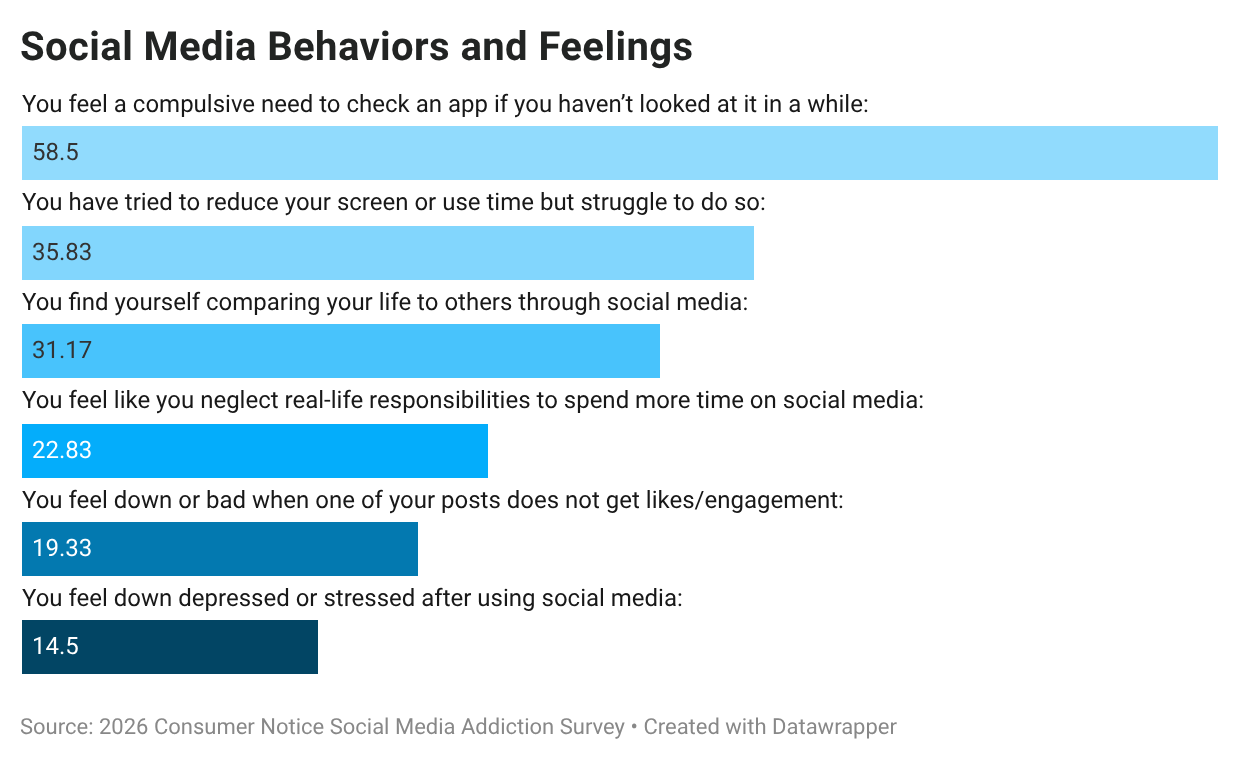
Nearly 60% of respondents said that they felt a compulsive need to check social media if they hadn’t in a while, a hallmark sign of addiction. About a fifth of respondents reported feeling down or bad if their posts did not get likes or engagement.
Part of the discrepancy between the number of respondents who say they are addicted to social media and the number who experience symptoms could be rooted in how society views addiction.
“When asked about ‘addiction,’ most people envision the stereotypical ‘addict’ strung out on the streets, experiencing houselessness or legal problems,” Cort Dorn-Medeiros, a professor and researcher at Lewis & Clark College who specializes in the intersection of technology and mental health, told Consumer Notice. “Social media is, of course, a very different animal than substance use in that social media is not only socially acceptable but, in many ways, socially mandated. In that sense, even people experiencing serious problems due to their excessive social media use may not ascribe to the ‘addiction’ label.”
Notably, these figures were not static across different age groups. Americans aged 18 to 29 were significantly more likely to believe that they are addicted to social media. Only 34% of respondents from that age group answered that they are not addicted, compared to 50% for all other age groups.
Younger users were also more likely to compare their lives with others’ on social media.
Most Americans Are Aware of Social Media Lawsuits — And Agree With Claims
The companies behind the most popular platforms are facing thousands of social media addiction lawsuits, claiming their apps have helped to fuel a mental health crisis across the country.
While cases have only just begun to advance to trial this year, more than 58% of respondents said that they were aware of these lawsuits.
“There has been a turning of the tide here in recent years,” Dorn-Medeiros said. “More information and evidence have come out recently about big tech companies intentionally using known addictive measures and manipulating the human psyche to bring in new users and keep them scrolling.”
In March 2026, Meta and Google were ordered to pay $6 million at the conclusion of a landmark trial. That case involved a 20-year-old woman who said that she went on to develop severe mental health issues after using YouTube and Instagram from a young age.
Most Americans agree that social media companies have intentionally worked to addict their users.
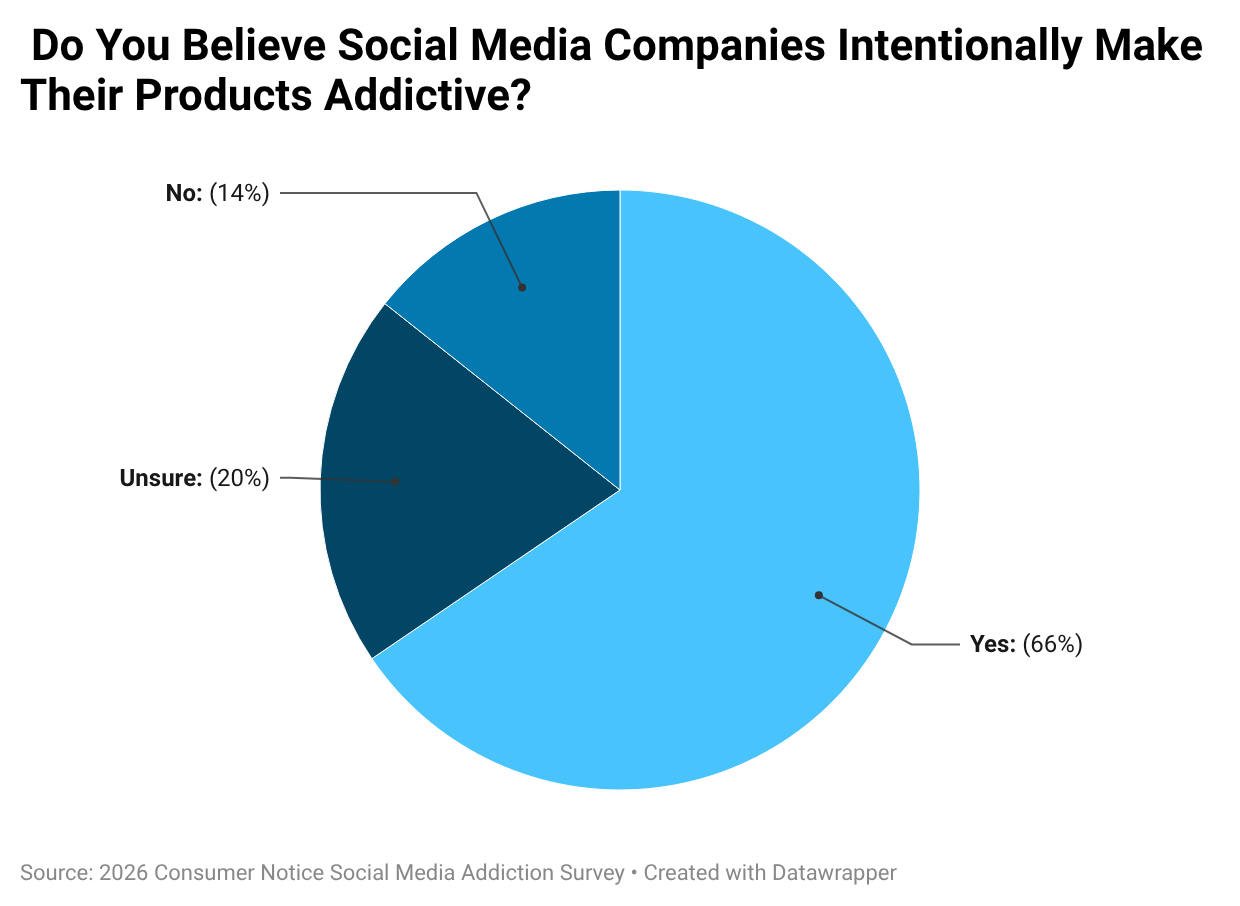
The vast majority of Americans either believe tech giants make their products addictive or are unsure on the issue, with fewer than 15% of respondents believing that companies do not do this.
Younger users were also more likely to believe that social media is intentionally addictive, with about 73% respondents aged 18 to 29 responding that companies deliberately created addictive services.
Americans View TikTok as the Most Addictive Platform
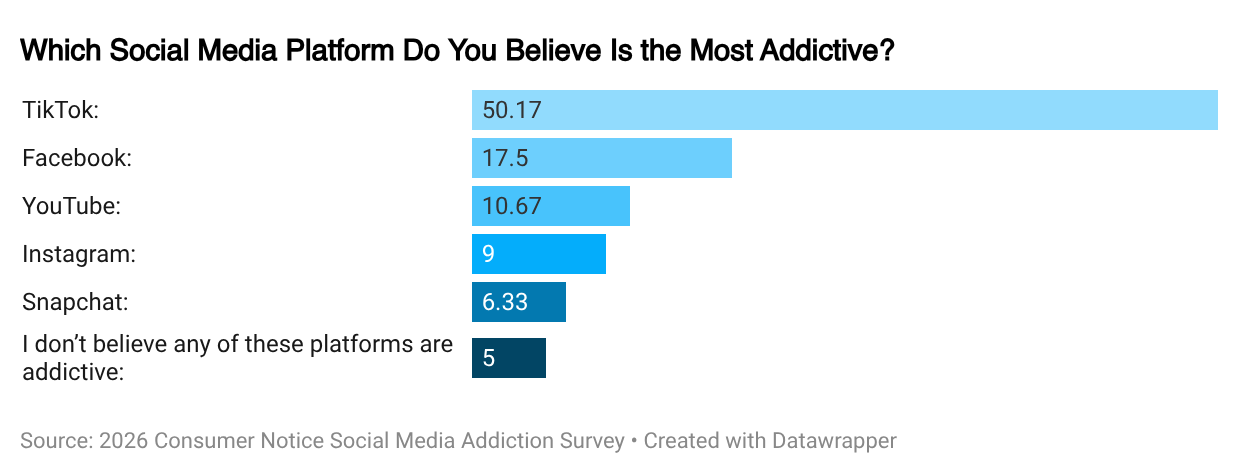
When asked about which popular social media platforms are the most addictive, more than half of the respondents singled out TikTok.
The app’s main attraction is a feed of videos users can continuously swipe through, built with features that lawsuits have pinpointed as hallmarks of fueling addiction. This includes algorithmically generated content that adapts to users’ preferences and an endless scroll, where users never run out of new content to view.
So far, no TikTok lawsuits have advanced to trial. The company has repeatedly reached confidential social media settlements with people who have filed lawsuits as those cases approach trial.
Second on the list was Facebook, with more than 17% of respondents selecting it as the most addictive platform. Meta, which owns both Facebook and Instagram, agreed to a settlement that could be worth as much as $18 billion with a group of states shortly after this survey was conducted.
That settlement ended an ongoing trial between Meta and U.S. states over both addiction claims and arguments that the company had violated the Children’s Online Privacy Protection Act (COPPA) through its data collection methods.
“There are regulations around the personal information that [websites] collect from children or people under 18,” Peter Salib, an associate professor of law at the University of Houston, told Consumer Notice. “So, there are some allegations that the Meta platforms were directed to children and then didn’t comply with those data collection restrictions.”
As part of the deal, Meta agreed to make several platform changes for young users, including daily screen limits and restrictions on overnight access.
“What makes this settlement historic is not just the dollar amount. It’s that for the first time, a major social media platform has agreed to fundamentally change how it operates to protect children,” said Whitney Ray Di Bona, attorney and consumer safety advocate at Drugwatch. “Whether those changes will be enough remains to be seen, but this is a significant step in the right direction.”
Children Are a Primary Concern of Social Media Addiction
Much of the ongoing social media litigation specifically involves the impact of these products on children. About 69% of respondents to Consumer Notice’s survey said that they feel social media addiction is a particularly serious issue for young users.
Parents have also expressed significant concerns as they raise their children in an increasingly online age.
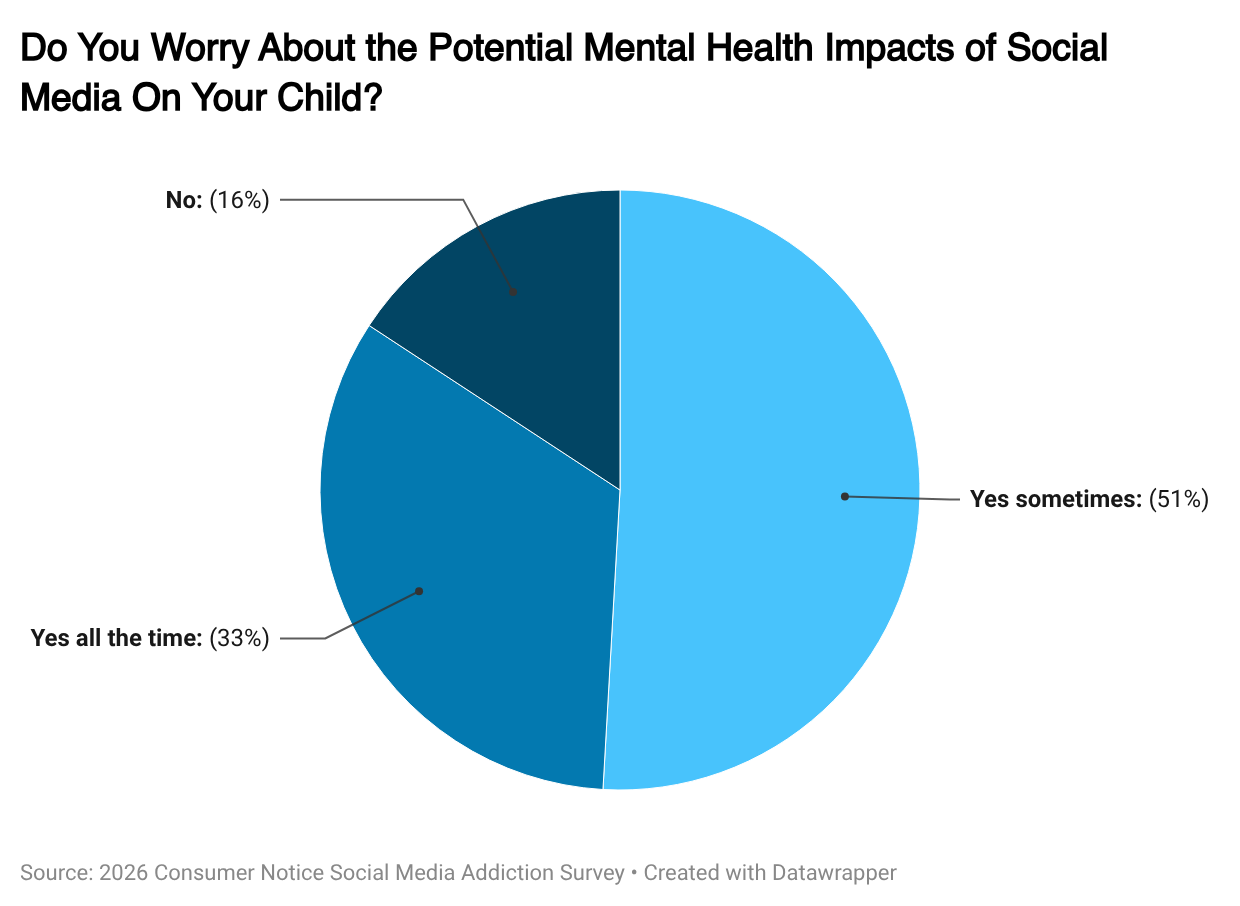
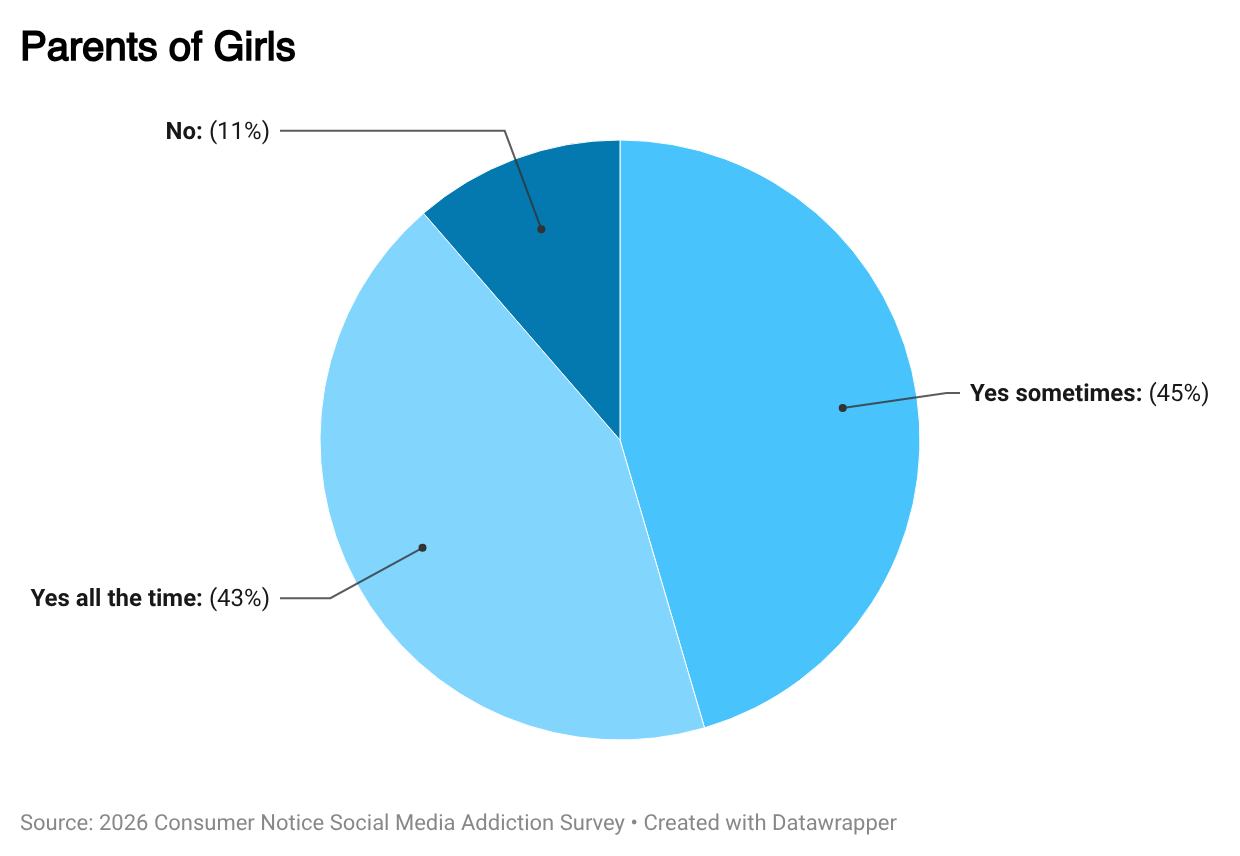
More than 84% of respondents who are parents said that they worry about the mental health impacts of social media on their children, with a third of parents saying they worry about this “all the time.”
Parents of girls were particularly likely to view this as a concern, with more than 43% saying they worry all of the time and only about 11% saying that they don’t worry at all.
Much of the scrutiny toward social media has focused on how photo-first platforms like Instagram may play a role in worsening body dysmorphia, eating disorders and other serious mental health issues.
Leaked internal documents referenced in the social media lawsuits revealed, for example, that Meta’s own researchers found that 32% of teen girls who already felt bad about their bodies felt even worse after using Instagram.
Americans Want Changes Made to Social Media Platforms
The vast majority of respondents approved of some sort of change to be made to popular social media platforms that could help combat addiction and protect children.
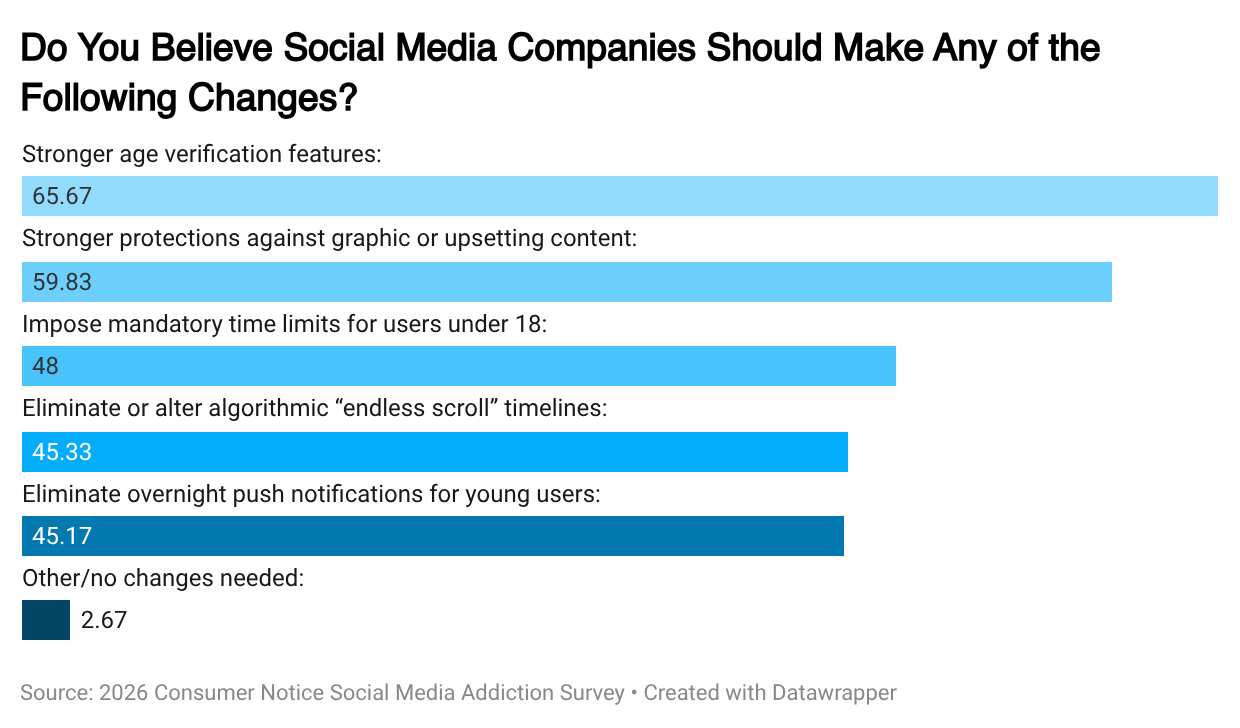
The most popular change that Americans want to see is more stringent age-verification features.
“That suggests people aren’t necessarily advocating for social media itself to disappear,” Dorn-Medeiros said. “Rather, they seem to support better guardrails, particularly for children and adolescents who are still developing the ability to regulate attention, impulses and behavior.”
While many social media apps do currently include some form of age verification, thousands of lawsuits claim that these features are defective and easily bypassed, allowing young users to navigate these apps freely with few to no limitations.
Another top choice was implementing stronger protections against graphic or upsetting content, with about 60% of respondents calling for this change.
In August 2026, Bloomberg reported that TikTok ran an experiment that included withholding a safety feature that could prevent users from seeing significant amounts of harmful content for 10% of Americans who use the app.
One teen who was included in that group died by suicide after viewing thousands of videos about sadness and loneliness.
What Comes Next For Social Media Addiction?
Part of what makes the path forward for the response to social media addiction so murky is users’ complicated relationships with these apps. Even heavy users who experience signs of addiction may still feel they get more benefits from using these platforms than they would be willing to give up.
“Problematic technology use rarely feels bad in the moment. That’s part of what makes it difficult to recognize as a problem to begin with,” Dorn-Medeiros said. “We tend to think something is only a problem if it makes us miserable, but people can enjoy social media while simultaneously feeling like they have less control over their use than they would like.”
But the coming months could be key to determining the future of social media in the United States as more addiction lawsuits advance to trial and cases brought by state attorneys general play out.
The completion of Meta’s $18 billion settlement, and whether it puts pressure on other companies to follow suit, will be important to watch.
Some of these companies, including TikTok and Snap, have also repeatedly settled individual lawsuits as they near trial. More pressure could mount for a wider settlement if this trend continues, particularly since the only case to go before a jury so far ended in a $6 million verdict.
Pressure against these companies is increasing internationally as well. Australia recently became the first nation to ban social media use for children under 16, and Canada and the United Kingdom could soon follow suit.
California is also weighing a similar ban, which would be the first of its kind in the United States.
“The momentum against social media companies is building on every front, in courtrooms, in state legislatures and now internationally,” Di Bona said. “What we are seeing unfold right now is just the beginning. The real question is no longer whether these platforms will be held accountable. It’s how far that accountability will go and how quickly change will actually reach the children who need it most.”
Please seek the advice of a qualified professional before making decisions about your health or finances.

Christian Simmons is a writer for ConsumerNotice.org has worked professionally as a journalist since 2016, covering a variety of important topics.


Consumer Notice, LLC content is legally reviewed for accuracy and quality.
Examples of trusted legal reviewers include qualified mass torts lawyers and certified paralegals.
Consumer Notice, LLC writers gather lawsuit information by studying court records, watching lawsuit proceedings and speaking with experienced attorneys.
Calling this number connects you with a Consumer Notice, LLC representative. We will direct you to one of our trusted legal partners for a free case review.
Consumer Notice, LLC's trusted legal partners support the organization's mission to keep people safe from dangerous drugs and medical devices.
844-420-1914